curriculum at springwell special school
At Springwell Special School, our curriculum is built on our vision, our values and a commitment to preparing every pupil for their next steps. We believe true preparation goes beyond academic grades. It is also about nurturing the empathy and character needed to build and sustain successful relationships, and the values and norms to become active and responsible citizens. To achieve this, our teaching is underpinned by the science of learning. We adopt a cumulative approach, which helps pupils to ‘know more and remember more’ and place a specific emphasis on building strong foundations in communication, language, literacy and mathematics. By ensuring these core building blocks are in place, we give pupils the tools they need to unlock the rest of the curriculum.
IMPLEMENTATION
To do this we:
Utilise Read Write Inc. to build a strong foundation, systematically teaching pupils the relationship between sounds and written symbols to ensure accurate decoding.
Implement specific strategies to develop oral language, improve reading fluency and comprehension, and study a diverse range of texts.
Deliver a curriculum that prioritises spoken and written vocabulary development across all subjects, not just within English lessons.
Schedule dedicated time for both whole-class and individual reading, while offering a comprehensive range of interventions for pupils who need additional support.
INTENT
As a school we are determined to:
Teach every pupil to read and keep them reading - no exceptions
Actively engage with pupils’ EHCPs and check that pupils are able to verbalise their outcomes.
Deliver quality first teaching.
Remove barriers to learning.
Offer carefully planned interventions.
Check our pedagogical choices against the available evidence.
Ensure every pupil meets the objectives set out in their Education Health and Care Plan
Use a pedagogical approach suited to the needs of our pupils, including those with SEMH, ADHD, ASD and C&I needs.
Explicitly map out and connect the different types of knowledge found within each subject across terms, years and phases.
Sequence lessons so that pupils can build on prior learning.
Plan regular opportunities for retrieval practice.
Provide a carefully crafted curriculum, which prepares pupils for their next steps
Plan activities that support the development of social skills and social communication.
Explicitly teach strategies that support self-regulation.
Embed opportunities for pupils to develop emotional resilience.
Model and nurture positive relationships and strong partnerships
Our Curriculum Model
Our curriculum is anchored in our core values through three phases known as Curiosity, Courage and Pride. To guarantee progression, we sequence learning at two distinct levels. We begin with frameworks that map essential knowledge year on year, which teachers then adapt into responsive plans based on individual pupil profiles.
Using the curriculum as our progression model, we assess pupils each half term against specific goals, validating progress through teacher assessment, work scrutiny and ‘WOW work’. Rigour is maintained through the online platform Learning Ladders, which helps us design unique pathways and share progress with pupils and their parents. Crucially, it ensures no child is left behind by helping us swiftly identify those who need to secure foundations in communication, literacy and numeracy.
Meeting Pupil Needs
As a special school, we adopt an approach that meets the needs of our cohort recognising both their primary and secondary needs.
Organisation
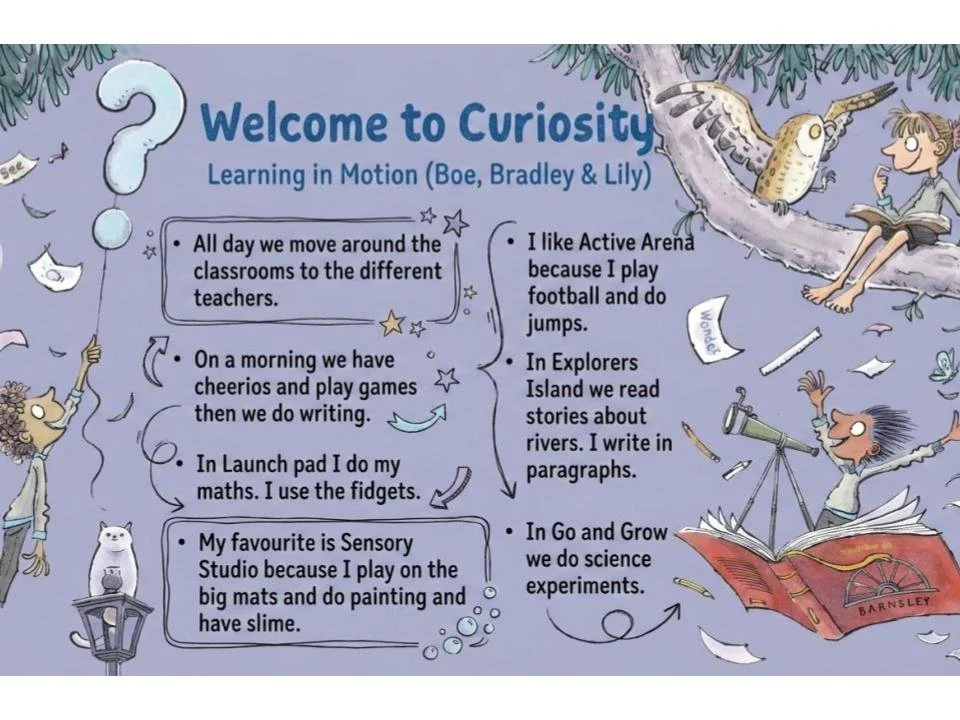
Curiosity
Curiosity refers to our primary curriculum. In this phase, some subjects are delivered as discrete subjects and others are delivered via a thematic approach. This hybrid model is intentional. We teach subjects like maths and languages separately to ensure children gain the step-by-step building blocks they need to be confident and competent. However, we use topics to bring learning to life. By weaving subjects like History and Geography together into a theme, we spark children’s imagination and help them see how the world fits together. To support this, we utilise distinct learning spaces for different subject groups. By physically moving to specific environments, children learn to associate a particular space with a specific area. This environmental cue helps them ‘switch on’ the right mindset as soon as they step into the room, creating an immersive and focused experience.
We cover the national curriculum as follows:
We secure the core pillars of learning in Launch Pad, where the focus is on explicit instruction in vocabulary, grammar and spelling and Mathematics.
This literacy foundation is deepened in Explorer’s Island, where History, Geography and RE serve as rich contexts for the distinct teaching of English (Spoken Language, Reading, Writing).
Grow and Go covers Science, Design Technology (DT), and PSHE requirements, integrating scientific enquiry with essential life skills and design thinking.
Creative and emotional development are prioritised in the Sensory Studio, which delivers the Art, Music and Drama curriculum through sensory exploration and emotional literacy.
The Active Arena fulfills Physical Education requirements by fostering a love of movement and enhancing gross motor skills, while simultaneously supporting proprioceptive development and positive social interaction for all pupils.
Courage
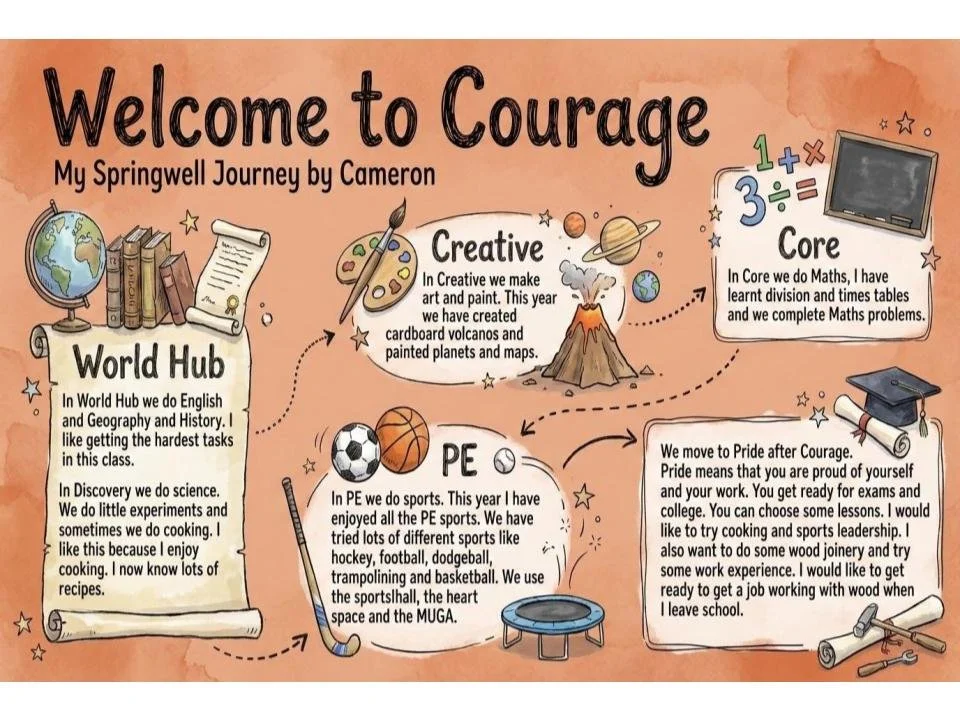
We continue this approach into year 7, ensuring coverage of the national curriculum through specialised learning hubs. We prioritise fundamental academic skills in Core, a dedicated space focused on mastering Mathematics and essential Spelling, Punctuation, and Grammar (SPaG). In World Hub, pupils explore History, Geography and RE, using these subjects to significantly strengthen their English reading and writing skills. The Discovery Lab takes Science beyond the textbook, combining scientific inquiry with PSHE and Life Skills to help pupils understand the world and technology around them. Creative subjects are taught in the Creation Lab, covering Art, Drama and Design & Technology to build problem-solving skills and confidence in self-expression. Finally, the Physical Curriculum meets all PE requirements, encouraging pupils to compete in sports, build physical strength, and learn the important values of fairness and respect.
Pride
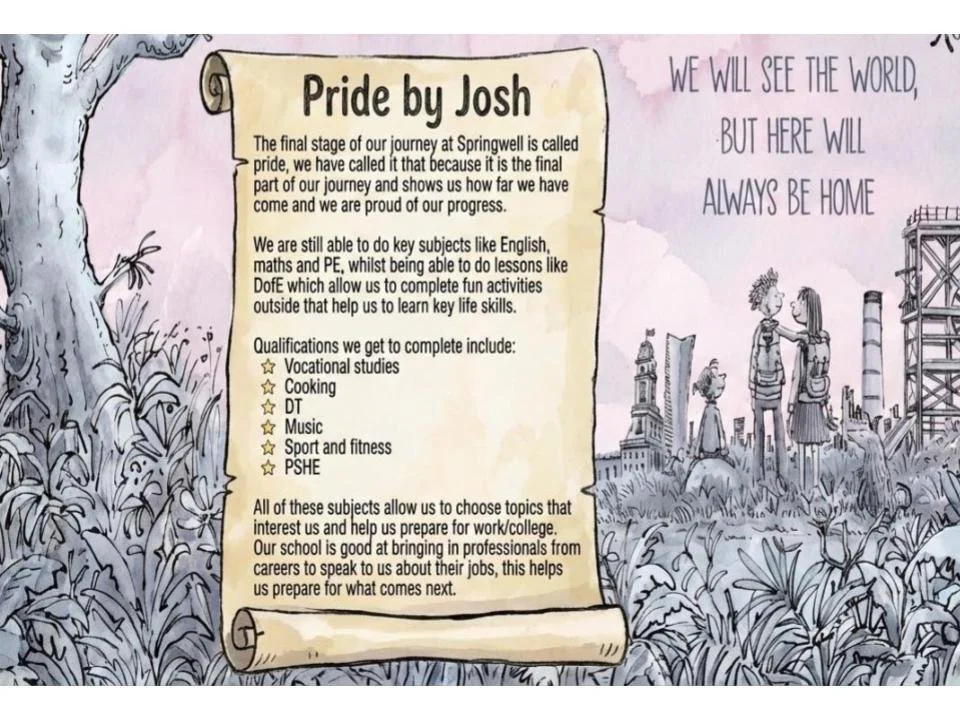
In Key Stage 4, we start to focus on pupils’ long-term goals and adjust our curriculum accordingly. Every pupil continues to study English, maths, PE and outdoor learning, as well as PSHCE with RSE. Pupils then access a range of accredited courses that are updated on an annual basis according to their needs and aspirations. This includes qualifications in Citizenship, Music, Design Technology, Food Technology, Sport and Fitness and Music. Where we don’t have a specialist onsite, we work with external partners to enhance our offer.
Careers
Our careers programme is built on the Framework for Careers, Employability and Enterprise Education developed by the Career Development Institute (CDI). This framework covers 17 key areas structured around the four core aims of:
Developing yourself through careers, employability and enterprise education
Learning about careers and the world of work
Developing your career management, employability and enterprise skills
This programme takes account of the Gatsby Benchmarks offering a stable careers programme that includes good quality information about future study options and labour market opportunities. Issues related to equality and diversity are embedded throughout. In addition all our teachers ensure curriculum coherence by making links with other areas; differentiate to meet the needs of individuals; identify locally-relevant contexts for framing core concepts.
Extra-Curricular Activities
Extra-curricular activities are an important and exciting feature of school life and contribute enormously to our pupils’ social and academic development. There is an extensive menu of extra-curricular activities on offer, including arts and sporting provision, with opportunities to take part in workshops and field trips. We also offer pupils the chance to experience different cultures and experiences through our range of local and national trips and visits. Theatre trips, visits to exhibitions and museums plus excursions to local colleges occur regularly and provide further opportunities for pupils to enrich and extend their learning beyond the classroom.
Personalised Provision
Where the additional or special educational needs of pupils are such that they require bespoke or specialist support, we work with parents and relevant professionals to build a package of personalised provision. Our offer for these pupils is rooted in the solid consensus that they need to prioritise the development of attendance, attributes and behaviours that will:
Keep them safe in school and in the community;
Support them to access the wider curriculum over time;
Support their transition to a more appropriate setting, if required;
Enable them to take advantage of opportunities, responsibilities and experiences later in life
These intensive packages are agreed through the annual review process and reviewed on a regular basis.
curriculum at the alternative academy
The curriculum at Springwell Alternative Academy is also guided by our vision and values and shaped by our agreed mission. Our pupils join us after a period of disruption to their education so our overarching goals are to understand the barriers to education that mean mainstream has not worked for the individual, to plan a programme of interventions to address these barriers and to ensure learners are thoroughly prepared for their return to a mainstream setting or their next steps.
Our Curriculum Model
Our curriculum is ever evolving to reflect the needs of our changing cohort. For this reason, many of our planning documents remain ‘live.’ However, long term plans support those who attend for extended periods and medium term plans detail the specific knowledge that pupils will gain every half term taking into account their different starting points. Medium term planning will be carefully sequenced and highlight key skills and knowledge required for any given topic.
Assessment
On arrival pupils are assessed to ensure we have a robust understanding of their starting points. Pupils are then assigned a pathway for pastoral support and allocated to a suitable class. Pupils are also allocated to a ‘next steps’ pathway that looks at whether their next steps are Post 16, SEND pathway or a reintegration to a mainstream setting. Pupil progress is monitored on a regular basis depending on their length of stay. Progress is monitored through progress meetings, moderated work scrutiny and teacher assessment. Our assessment model acknowledges that our students may have had disruption to their learning and at times, assessment processes may need to utilise a supportive and discrete approach.
Our Approach
Our approach is aligned to the individual needs of pupils. For some, we use an instructional approach that mirrors that of an inclusive mainstream school. For others, we are mindful of their lived experiences and employ trauma-informed practice and nurture principles. For some pupils, we utilise a personalised approach that is specifically matched to their additional or special educational needs.
The ‘Expert Practitioner’ Teaching and Learning Model is a framework designed by Alternative Academy staff to ensure every student receives a quality-first teaching offer. The model is built upon a foundation of high standards and positive relationships between students and staff, fostering an optimal classroom environment. Core practice integrates Adaptive Strategies and Cognitive Load Theory (CLT), which underpin all aspects of the approach. The model is built upon academic and scientific research to ensure effective support of students. The teaching cycle consists of five clear steps.
Curriculum Entitlement
Students access a range of subjects as follows:
Primary
English, Phonics (Read Write Inc.), Maths, PSHE, Personal Development, PE, Cooking, Elements
KS3
English, Maths, PE, Elements, BTEC Food Nutrition, PSHCE, Citizenship, Art, Duke of Edinburgh
KS4
GCSE English Language, GCSE English Language, GCSE History, GCSE Science, GCSE Maths, GCSE Statistics, GCSE Food, Nutrition & Preparation, Duke of Edinburgh, Careers, PSHE.
*Elements is a thematic approach to the teaching of Humanities (Geog, History, RE, Citizenship) that helps pupils to link subjects and develop their interest by studying a topic more deeply.